Elizabeth Bohlinger’s funeral and luncheon
The Life ListElizabeth Bohlinger’s funeral and luncheon is the first public observance of her death and the moment Brett Bohlinger’s private grief spills into the gathering meant to honor her mother. In the bedroom above the guests, Brett seeks refuge among Elizabeth’s belongings, opens a bottle reserved for a hoped-for recovery, and finds a journal with a message asking her to wait until she feels stronger before reading it. Her attempt to return to the luncheon ends in a stumble down the staircase; afterward, the assembled guests and the cleared rooms frame a loss that feels both unreal and newly, repeatedly present.
The gathering and the retreat
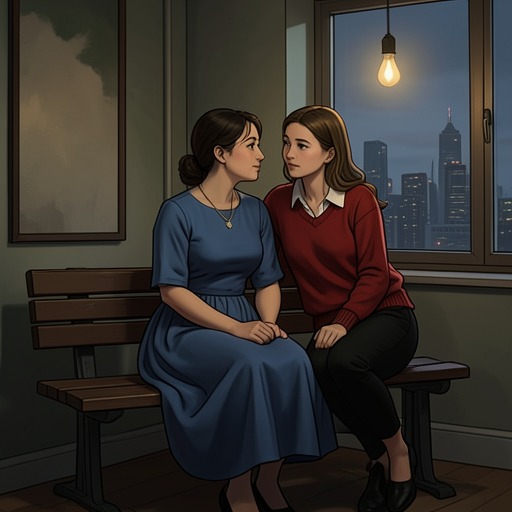
The event unfolds across two sharply different spaces. Voices from the dining room rise through the house, indistinct and intrusive, while Brett shuts herself in Elizabeth’s bedroom and leans against the door. Familiar traces—the scent of perfume and goat’s-milk soap, the creak of the iron bed, and memories of her mother comforting her there as a child—make the room a refuge within the funeral gathering. Brett thinks of Elizabeth as the person who had been steadier than any house, and resolves that the bed is hers to keep. That claim is less about furniture than about trying to hold on to a place shaped by their life together.
The contrast between the luncheon downstairs and the silence upstairs gives the event its emotional structure. Brett wants to honor her mother by joining the mourners, but cannot yet bear the ceremony without escaping it. The bedroom lets her grieve in private; its familiar comforts also make leaving it difficult. When she finally rushes back toward the guests, the movement from seclusion to public view turns inward anguish into a visible, humiliating incident.
Champagne, medicine, and the journal
In Elizabeth’s closet, Brett finds a bottle of Krug tucked among her shoes. It had been bought after Elizabeth’s first doctor’s appointment and saved for a celebration after treatment, when she hoped to receive a clean bill of health. For Brett, opening it at the funeral reverses its intended meaning: the champagne meant to mark recovery becomes a toast to a mother who has died. She drinks to Elizabeth and to the pride she felt in being her daughter, even as the bottle’s original promise makes the loss harder to ignore.
The cork knocks over a bottle of Kytril from Elizabeth’s bedside table. Gathering the tablets, Brett remembers offering her mother one after chemotherapy, then lying beside her as the medicine eased her nausea enough for sleep. The memory recalls a reversal of care: Elizabeth had once held and comforted Brett as a child, and Brett later tried to comfort her mother through treatment. Brett returns the tablets to their prescription bottle and leaves it by the bed, only to recognize that Elizabeth will never need another pill. The gesture briefly treats the room as if her mother might still return to it; that recognition makes the absence newly concrete.
Beside the champagne, Brett discovers a slim, weathered red journal tied with a faded yellow ribbon. Elizabeth’s gift tag tells Brett to save it for a day when she is stronger and, for the present, raise a glass to the two of them. Brett wants to read the journal immediately, but imagines her mother gently reproving her impatience. She puts it aside and promises to wait. The journal thus carries both a future connection to Elizabeth’s private thoughts and a limit set by Elizabeth herself: Brett can accept the comfort of what her mother left without taking it all at once.
The fall and the return to grief
The champagne dulls Brett’s pain, and she lies beneath the down comforter, allowing herself one more moment away from the funeral party. A knock brings the luncheon back into view. She hurries out, struggling to fit her swollen feet into her black pumps, while Catherine calls after her to stop. Brett is halfway down the staircase when her ankle twists. Guests turn to watch as she lands in the foyer in a heap, her dress hiked up and one shoe missing. The intended passage back into the gathering becomes an accidental spectacle: Brett is trying to honor Elizabeth, but grief and impaired balance leave her exposed before the mourners.
Brett later wakes to the clatter of dishes and finds workers stacking plates and glasses into plastic bins. For a moment she expects her mother to be there with an aspirin; then the scene’s ordinary signs of the luncheon ending bring her loss rushing back. The quickness of Elizabeth’s illness and death makes the death feel almost unreal to Brett, and she describes having to encounter the tragedy again when she wakes having momentarily forgotten it. The gathering therefore offers no clean passage from mourning to acceptance. Its ending—guests gone, dishes packed away—only leaves Brett alone with the permanence of the absence.
What remains after the luncheon
The funeral’s objects and memories continue to give Brett ways to address Elizabeth after the ceremony. In a later letter, Elizabeth acknowledges Brett’s sorrow and imagines embracing her or taking her to lunch to listen to her fears. Brett also remembers how readily her mother welcomed a funny story and asked to hear it over dinner. While preparing for a comedy performance, she finds that the impulse to share something amusing still turns her thoughts toward Elizabeth. The loss is present not only in moments of anguish but in ordinary experiences that Brett would once have brought to her mother.
A photograph of Elizabeth at the ceremony where she was named Chicago’s Businesswoman of the Year similarly becomes a focus for Brett’s later grief. Looking at her mother’s image, Brett asks whether Elizabeth meant to ruin her life by leaving her with the consequences of the goals imposed by her will. Later still, a letter from Elizabeth tells Brett that the man she is dating is not right for her and urges her to keep trying; Brett receives the message as permission to leave the relationship. These later moments show the funeral as an early scene in an ongoing bond: the journal, photograph, and letters keep Elizabeth present in Brett’s decisions, even as Brett must face the fact that her mother cannot answer in person.